

Gas Fireplace Inserts & Installation
Turn your existing wood-burning fireplace into a convenient source of warmth with a Kozy Heat gas insert. Thompson’s Hearth & Home has sold and installed Kozy Heat inserts since 2010, with personal guidance from owners Guy and Nicole Thompson and installation by our own in-house employees.
Visit our Issaquah showroom to compare models burning in person. We’ll help you choose the right size, flame appearance, and finish for your fireplace.
Why We Choose Kozy Heat
Our experience selling, installing, and servicing fireplaces guides the products we carry. We focus on Kozy Heat gas inserts because we value their realistic fire appearance, heating performance, controls, and manufacturer support.
Available for natural gas or propane, these inserts offer adjustable heat and convenient operation without handling firewood or cleaning up ash. We’ll help you select a model suited to your room and explain how its features work in everyday use.
Thompson’s Hearth & Home is licensed, bonded, and insured, with our own experienced in-house installation team. You’ll work with a family business that understands your installation and remains available for support after the sale.
Choosing Your Gas Insert
What’s the difference between a gas insert and a gas fireplace?
A gas insert fits inside a suitable existing wood-burning fireplace. Compatibility depends on the fireplace’s construction, dimensions, condition, and the insert manufacturer’s requirements.
A built-in gas fireplace is installed into a framed enclosure. It is typically used for new construction, remodels, or replacement of an existing built-in fireplace.
If you’re unsure what you have, send us photos and any accessible manufacturer label. We’ll help identify the appropriate options. You can also explore our gas fireplaces.
Where do you install gas inserts?
We install gas inserts in Issaquah, Bellevue, Sammamish, Mercer Island, Fall City, Snoqualmie, North Bend, and nearby Eastside communities. Gas inserts for Mercer Island homes
Keeping our installation area close to our Issaquah showroom helps us provide responsive support. Gas-appliance service is available to customers whose units we installed.
How do we get started?
Bring a photo of your fireplace and the opening’s width and height to our showroom, or contact us to send your information.
Include a wider photo showing the mantel, hearth, and surrounding wall. These details help us assess suitable models and identify anything that needs closer inspection.
If we need an in-home assessment to confirm the proposed installation, we’ll arrange it at no additional charge within our installation area.
Use our measuring tool below to help gather the dimensions.
Gas Insert Pricing & Installation
How much does a gas insert cost installed?
Our typical installed Kozy Heat gas-insert packages range from $5,400 to $6,900, depending on the model, options, and installation requirements. These are our published 2026 prices and are subject to change.
Our standard package includes:
The gas insert.
Shipping and delivery.
Vacuuming the existing fireplace.
Dual chimney liners extending to the chimney top.
Professional installation, setup, and connection.
A thermostat-controlled remote.
Electronic ignition with battery backup.
Connection to an existing suitable gas supply inside the fireplace.
Plug-in connection to an existing suitable electrical outlet.
New gas piping, a concealed electrical outlet, permit fees, custom work, and additional inspection trips may cost extra. Your estimate will identify the work included in your particular installation.
Will the insert work during a power outage?
Yes—the Kozy Heat inserts we offer can provide heat during an outage using their battery-backup system, provided the gas supply remains available and the batteries are properly installed and charged.
The burner continues operating, but the blower and accent lights require household electricity. You’ll still receive heat through radiation and natural convection, although heat distribution changes without the fan.
How much of your home it can heat depends on the model, floor plan, insulation, ceiling height, and outdoor temperature. We’ll help you choose an appropriate model and explain its backup operation.
What does adding a gas line cost?
When installed with a new gas insert, our gas-line pricing is $425 for the first 10 feet, plus $25 per additional foot.
This includes materials, installation, and pressure testing. We’ll confirm the route and available gas capacity when reviewing your project and identify any work outside the quoted scope.
Can the electrical cord be hidden?
Yes. We can refer you to a licensed electrician to install a suitable outlet inside the fireplace, typically for $425.
If you prefer us to coordinate payment on your behalf, the total is $475. The outlet location must meet the insert’s installation requirements.
What about permits and inspections?
We’ll identify the permit and inspection requirements for your address and project. You can arrange required permits through your building department, or we can handle the permitting process for an additional charge.
Permit fees are separate from the standard installation package unless included in your estimate.
When a new gas line requires our three-visit installation process, an additional $250 applies for the extra trips. Work is staged around gas-line pressure testing, appliance installation, and the required inspections. The sequence depends on the local building department.
Can you install an insert in an arched fireplace?
Often, yes. We have extensive experience fitting gas inserts into arched fireplace openings and using custom surrounds to create a finished appearance.
The opening’s dimensions and the selected insert determine what is possible. Send a photo and measurements so we can assess the fit.
See examples in our arched fireplace installation gallery.
What should I compare when choosing a gas insert?
Look beyond the flame picture and consider how the insert will perform in your home:
Fit: The appliance must suit your existing fireplace and meet installation requirements.
Heating range: Compare both maximum output and how far the flame can turn down for milder weather.
Efficiency: Compare ratings measured using the same efficiency standard.
Glass and fire appearance: View the flames, logs, and ember bed in person.
Controls: Try the remote, thermostat functions, flame adjustment, and fan settings.
Sound: Listen to the blower at different speeds.
Service support: Consider parts availability, warranty support, and who will service the appliance.
We’ll explain these differences in the showroom and help you choose based on your priorities and our experience installing and servicing the products.
Operating Costs & Everyday Questions
How much does a natural gas insert cost to run?
Operating cost depends on the burner’s gas input, your current gas rate, and how long the burner runs.
Natural gas is billed in therms. One therm equals 100,000 BTUs. To estimate the burner’s hourly fuel cost:
BTU input per hour ÷ 100,000 × gas price per therm = hourly fuel cost
For example, at an illustrative rate of $1.58 per therm:
A burner using 25,000 BTUs per hour costs approximately 40 cents per hour.
At 12,500 BTUs per hour, it costs approximately 20 cents per hour.
Actual low-fire input varies by model. Thermostat cycling can reduce total burner operating time.
Use the current usage-based gas charges on your utility bill for your own estimate. These examples exclude pilot consumption, blower electricity, and fixed monthly utility charges.
What’s the difference between intermittent and continuous pilot operation?
Intermittent pilot operation lights the pilot when heat is requested, reducing pilot gas consumption between uses.
Continuous pilot operation keeps the pilot burning between heating cycles, subject to the control system’s automatic timeout. This can help keep the firebox warm and establish draft in colder conditions.
We’ll explain the settings available on your model and when each may be useful.
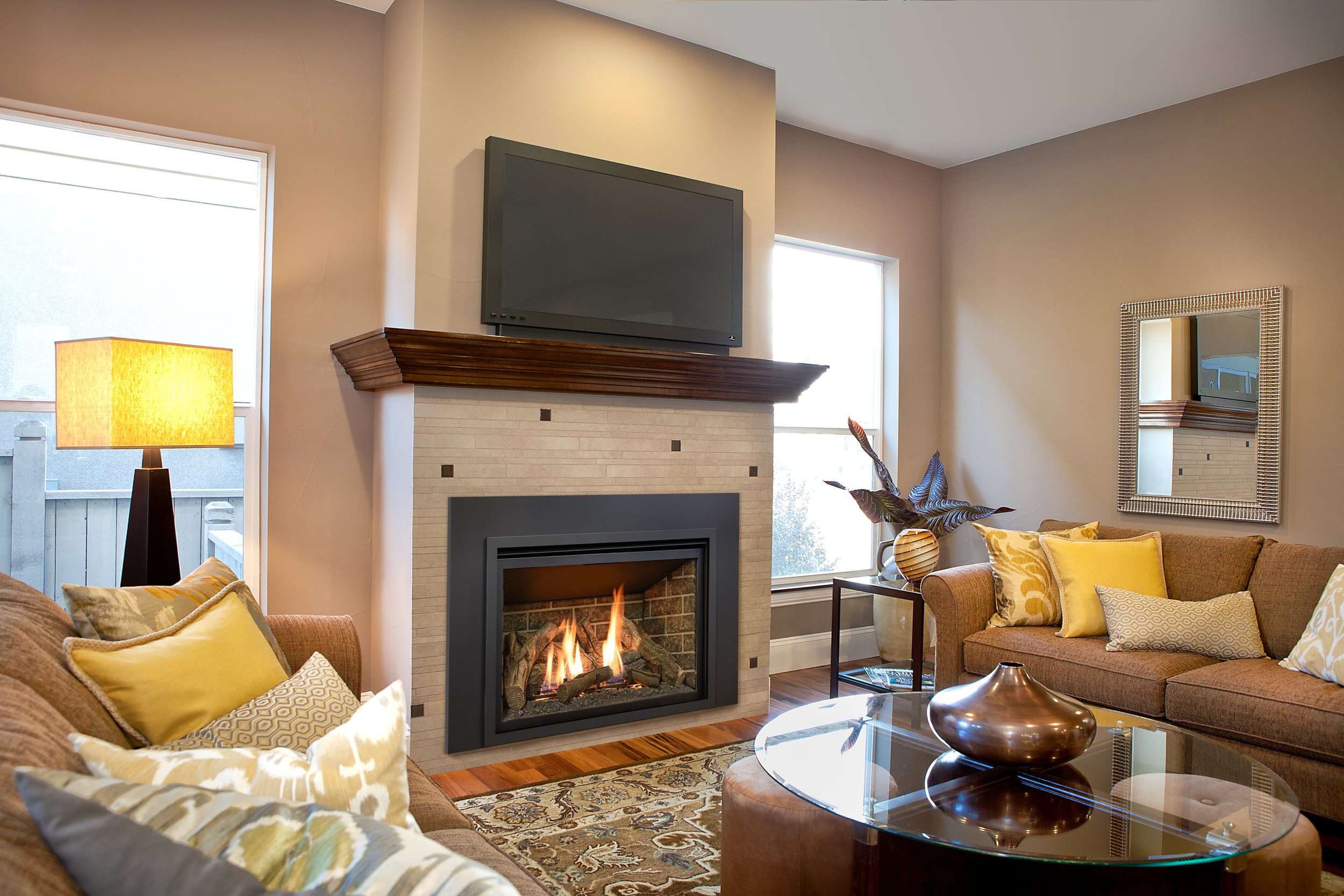
Can we put a TV above the fireplace?
It may be possible, but the complete arrangement needs to be evaluated.
The insert’s installation requirements, mantel height and depth, heat exposure, and the TV manufacturer’s temperature limits all matter. A mantel can help deflect heat, but its presence alone does not establish that the TV is adequately protected.
Tell us early in the planning process if a TV is already installed or you intend to add one. Bring a photo showing the fireplace, mantel, and proposed TV location.
Do you offer sales or discounts?
We focus on straightforward everyday pricing. For more than 10 years, we haven’t found it necessary to advertise, and we don’t build extra margin into our pricing to fund recurring promotional discounts.
Our pricing supports quality products, experienced installers, and personal service before and after the sale.
However, 3% is built into our pricing to cover credit card processing costs. If you pay by a method other than a credit card, we’re happy to pass that 3% savings along to you.
Find the Right Insert for Your Fireplace
Visit our Issaquah showroom to compare Kozy Heat gas inserts burning in person. Bring photos and basic measurements, and we’ll help you understand the options, installation requirements, and pricing for your home.
If you have made it this far then you might be interested in looking at the brochure!





• For more information visit •